Improved Paper Machine Efficiency through Shower Water Heating
An Interview with John Neun – Consulting Engineer
John, please summarize your background in the Paper Industry.
I began in the paper industry in 1979, working for R&D at what was then Albany Felt Company. My background is Mechanical Engineering, in which I have Bachelor's and Master's degrees. Since 1979, I’ve spent most of my career with Albany International and Kadant working in R&D and a great deal in field service and support, which means I’ve had the opportunity to see hundreds of paper and tissue machines in the US and around the world. I got to learn about and develop technologies for pressing, forming, vacuum systems, water use, and machine dynamics.
I retired from Albany International in 2016, and since then have stayed busy finding ways to improve paper machine wet end performance, energy efficiency, and water use. I’ve performed or participated in over 40 paper machine and paper mill water audits, identifying (by rough count) a total of over 45 million gallons per day in excess water use.
You’ve been involved in TAPPI over the years.
I’ve published many papers, mostly for TAPPI. I’ve been part of TAPPI for my whole career, and I’ve won the TAPPI Joachim Distinguished Service Award, leadership awards from both TAPPI Engineering and Paper & Board Divisions, the Engineering Division Technical Award, and I’m a TAPPI Fellow and past chairman of the Paper and Board Division.
It may not be a direct relationship between machine shower water heating and machine efficiency. Can you help us connect the dots?
From an energy transfer point of view, higher water temperature is good because hotter means less viscous fluid and therefore better flow. It takes energy to heat water, though, so the question becomes one of efficiency. That is, does performance improve with higher water temperatures enough to justify the cost? Decreased viscosity probably will not justify heating in itself, but especially in the press section, can increased water temperature effect press efficiency?
There are some factors to consider. First, it is generally accepted that a 1% improvement in press solids will decrease required dryer steam by about 4%. Next, according to TAPPI TIP 0404-63, “Paper Machine Energy Conservation,” an 18°F increase in sheet temperature will yield a 1% increase in press solids.

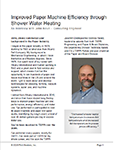
John Neun
“Increased shower water
temperature increases felt
temperature and increased
felt temperature improves
press efficiency.”
How much does shower water temperature affect sheet temperature?
As with most paper machine phenomena, the exact answer is different from machine to machine. However, consider what happens in a press nip. Water in the nip gets there via two vehicles: the sheet and the felt. For most nips, most of the water gets to the nip in the felt. For example, for a 50 gsm sheet that is 25% solids, the sheet brings 150 gsm of water to the nip. A 2000 gsm felt that is 66% dry brings about 1000 gsm to the nip. If the water in the nip coming from the sheet and felt is perfectly blended (and this might be an ideal but illustrates the point), the felt water temperature has a 6x or 7x more profound effect on nip temperature than does the sheet water.
If felt shower water is cold, the felt is cold. “Cold” means at a lower temperature than the sheet. If the felt is cold, then the nip is not as efficient as it could be.
How large is the effect? If shower water is at 70°F and the sheet is at 120°F, using the example above, the nip would be about 42°F cooler than the sheet (120 – 70 = 50, 50 x 5/6 = 42). That’s a potential loss of over 2% solids in the press, which is very significant.
As the felt leaves the nip, it has gained some water from the sheet. If the felt is showered, the mass of shower water is probably much greater than the water gained from the sheet, so the predominant temperature would be that of the shower water. A uhle box will tend to cool the felt as it removes water, but the heat capacity of the air pulled through the felt by the uhle box is much less than the heat capacity of the felt and the felt water, so cooling is probably not that great. Therefore, if shower water is at a lower temperature than the sheet, there is efficiency to be gained by raising its temperature.
What would be an optimum temperature for shower water?
If the logic of the above argument holds, then higher shower temperature is better. The above argument is somewhat simplistic though, because it does not consider other factors. A good, practical target for shower water temperature is white water temperature. That is, the shower water should be at the same temperature as the sheet. If there is room for increasing shower temperature beyond process temperature, such a change should be considered. Shower temperature has to be limited to a safe limit so there is no scalding hazard to operators.
There are always economic factors to consider. The cost of heating the water has to be justified by runnability improvements and down-stream energy savings.
As I mentioned, every paper machine is unique in its own way. A good preliminary assessment of viability of heating water is an examination of temperatures in an existing situation. Is the felt much cooler than the sheet? Is the sheet much cooler after pressing than before? Does the uhle box cool the felt more than I have indicated? These are all simple checks that can be used to help quantify potential.
With the increase in press temperature, can you put a number on the increase in efficiency?
In the example above, because shower water was cold, a 2% improvement in press solids or even better could be expected. Every situation will be different, but the heat balance around the nip will be critical everywhere. A 2% increase in sheet solids is very significant. Using the 1:4 rule of thumb, that’s a decrease of 8% dryer steam, which is a huge savings. The conditions of the example, especially 70° water, might be extreme, but the effects are real. Increased shower water temperature increases felt temperature and increased felt temperature improves press efficiency.
For every other shower on the machine, it’s a good idea for showers to be at process temperature. If they are not, the paper machine is essentially a closed system running at an equilibrium temperature, and if water enters below that temperature, it must be heated. That creates an energy cost.
Thank you for your time. Do you have anything you would like to add?
Shower water temperature is one of those things that is easy to ignore. You can “get by” with cold water, but because the machine runs better at higher temperatures, efficiency is lost. Consider our example. If the process is at 120°F and shower water is at 70°F, if steam costs $5 per MMBTU, one gallon of water costs about $1000/year to heat from 70° to 120°. If there are 350 gpm of shower water, that’s $350,000/year. It therefore makes sense to heat all shower water, not just those effecting press nip temperature.
Read part two: Putting the Theory into Practice with the Right Equipment or contact Pick Heaters.