
Direct Steam Injection Heaters vs. Indirect Heat Exchangers: Pros, Cons, and Key Differences
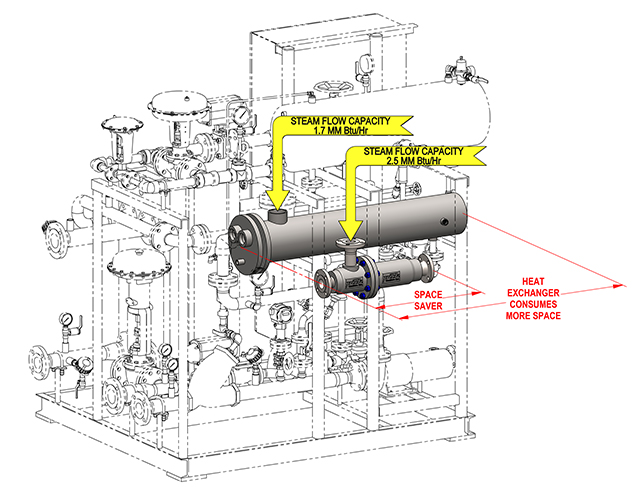
When it comes to process liquid heating in industries like food and beverage, chemical, pharmaceutical, and pulp & paper, two common technologies stand out: Direct Steam Injection (DSI) Heaters and Indirect Heat Exchangers.
Both have the same goal - heating fluids to precise temperatures, but they achieve it in different ways, each with unique advantages and drawbacks.
How They Work
- Direct Steam Injection Heaters
Introduce steam directly into the liquid stream, rapidly transferring heat as the steam condenses. This method allows near-instantaneous heating and high thermal efficiency since there’s no heat transfer barrier between the steam and the liquid.
- Indirect Heat Exchangers
Use a barrier to transfer heat across the surface area of a plate-pack or tube bundle using steam or another hot fluid to heat the product. The steam never contacts the liquid directly, which is critical for certain applications.
Pros and Cons
Direct Steam Injection Heaters
Pros:
- High Energy Efficiency – Nearly 100% of the steam’s energy is transferred to the liquid.
- Fast Heating – Instantaneous temperature rise, ideal for continuous processes.
- Compact Footprint – Smaller equipment size compared to many heat exchangers.
- Precise Temperature Control – Rapid adjustments possible with minimal lag.
- Lower Capital Cost – Often less expensive upfront for equivalent capacity.
Cons:
- Direct Contact with Steam – Requires high-quality culinary or sanitary steam in many food and beverage applications.
- Potential Product Dilution – Steam condenses into water, increasing liquid volume.
- Not Ideal for Some Sensitive Products – Direct steam contact may impact flavor, texture, or chemistry.
Pros:
- No Direct Steam Contact – Suitable for applications where steam purity or product dilution is a concern.
- Gentle Heating – Reduced risk of thermal shock or shear.
- Versatile Media Options – Can use hot water, thermal oil, or other heating fluids.
- Sanitary Designs Available – Common in applications where product integrity is critical.
Cons:
- Lower Thermal Efficiency – Heat transfer surface is subject to fowling.
- Slower Response Time – More gradual heating compared to DSI.
- Larger Equipment Size – Often requires more space due to surface area requirements.
- Higher Maintenance – Fouling, scaling, and gasket wear can increase upkeep costs.
Comparison:
|
Feature / Factor |
Direct Steam Injection (DSI) |
Indirect Heat Exchanger |
|
Heating Speed |
Instantaneous |
Moderate to slow |
|
Thermal Efficiency |
~100% |
Lower (only latent energy applied) |
|
Equipment Size |
Compact |
Larger |
|
Temperature Control |
Highly responsive |
Moderate responsiveness |
|
Steam Contact with Product |
Yes |
No |
|
Product Dilution |
Yes |
None |
|
Maintenance |
Lower (fewer parts) |
Higher (more components) |
|
Initial Cost |
Lower |
Higher |
|
Application Suitability |
Best for continuous, instantaneous heating |
Best for sensitive, non-dilutable products |
Both Direct Steam Injection Heaters and Indirect Heat Exchangers have important roles in industrial heating.
- Choose DSI if you need fast, efficient, and precise heating with minimal space requirements - especially in continuous processing lines where steam purity can be ensured.
- Choose Indirect Heat Exchangers when product integrity, non-dilution, or steam separation is essential, or when you must use alternative heating media.
In many facilities, these technologies even coexist, each used where it performs best. Selecting the right solution depends on your product, process requirements, and operational priorities.
Find which Pick Heater is best suited for your application needs.