
A Beginner’s Guide to Direct Steam Injection: Heater Sizing and Application Data
One common pitfall in direct steam injection (DSI) heating projects is incorrect heater sizing. Pitfalls can include oversized heaters, miscalculated duty requirements, or issues when combining heating and cooling in the same system. The good news? With the right application data, these problems are easy to avoid.
In this guide, we’ll cover three essentials for beginners:
- Why bigger heaters aren’t always better.
- How to calculate steam flow requirements.
- Tips for avoiding model mismatches — including special considerations for heating and cooling systems.
Why Bigger Heaters Aren’t Always Better
A common assumption is that oversizing a heater provides extra flexibility. In reality, over-sizing can be a source of instability.
- Problem: Large heaters don’t operate efficiently at low flows. This can cause temperature swings, poor control, and even premature wear on valves and injectors.
- Solution: Size the heater based on actual duty. A properly matched heater ensures stable operation across your expected flow range.
How to Calculate Steam Flow
Getting sizing right begins with a simple calculation. Here’s the basic process:
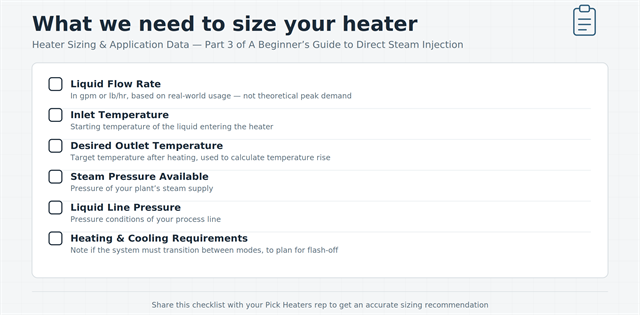
- Measure the liquid flow rate - usually in gallons per minute (gpm) or pounds per hour (lb/hr).
- Determine the temperature rise - the difference between the inlet and desired outlet temperature.
- Calculate the BTUs per hour - find the energy required to heat this fluid, 1 btu is needed to raise 1 lb of water 1°F.
- Apply steam tables - to calculate the pounds of steam required to achieve that temperature rise. With steam injection we take advantage of the total heat in each lb of steam.
Example: Heating 100 gpm of water from 60°F to 140°F requires about 4,000 lb/hr of steam when sizing for common heating methods like a heat exchanger using latent heat of the steam. Many customers are surprised to learn their actual needs are 20 - 30% less than initial estimates when using DSI. This is because with direct steam injection you can utilize the total heat of the steam rather than just the latent heat and the condensate that holds the sensible heat will also be consumed and added to the process.
Avoiding Heater Model Mismatches
Another frequent issue is requesting a heater model that doesn’t match the application duty. This leads to unnecessary cost, inefficiency, or worse - unstable operation.
Best practice: Always provide your full application data (flow, temperature rise, and pressure conditions) to the manufacturer. Size for real world application data (be aware of the potential for several 10% safety margins to stack). With accurate application data, the manufacturer can then recommend the right heater model and steam control setup. The clearer you are about what you need now and in the future, the better the system can be designed around the flexibility of the Pick system.
Example: Don’t just look at a P&ID and see 40 hose stations, then assume you need a heater sized to run all 40 at once. In reality, they won’t all be used simultaneously. If the sanitation team only has 10 people, the true maximum demand is likely just 10 hoses running at once. If you size the heater for all 40 hoses, you could end up with a system nearly four times larger than necessary. This could lead to issues with outlet temperature instability at low liquid flow rates, and temperature control issues.
Special Consideration: Heating & Cooling Systems
In some applications, systems must handle both heating and cooling duty. Take for instance, heating to a high temperature under pressure to circulate the water in a closed loop vessel jacket. This can introduce unique challenges:
Flash-off: When switching from heating to cooling, hot liquid is held under pressure and can suddenly flash some portion of its volume to steam when the pressure of the loop drops below the saturation pressure of the fluid. This causes cavitation, instability or noise and leads to premature pump and valve wear.
- Prevention: Use backpressure regulation, proper venting, and carefully designed piping to maintain system pressure during cooling modes and avoid flashing.
The key is planning the system for smooth transitions, not just peak heating duty.
Correct heater sizing is one of the most important steps in designing a direct steam injection system. Oversizing, poor calculations, or model mismatches can lead to temperature instability and wasted energy. By taking the time to calculate actual steam flow and sharing accurate process data, you’ll ensure your heater operates reliably and efficiently.
At Pick Heaters, we specialize in helping customers size heaters correctly for their unique applications. Whether you’re heating water, slurries, or food-grade products, we’ll ensure you get a system that’s right-sized for your process, not over-sized for headaches. Request a consultation and let us help you choose the right heater for your duty.